Showing posts with label Character Creation. Show all posts

Thursday, March 29, 2018

Beyond the Wall - Further Afield Review


If you've read my review of Beyond the Wall and Other Adventures, you know I think it's a great game for zero-prep one shots, but with the addition of the Further Afield supplement it becomes a great game for ongoing sandbox campaigns. Even if you don't use Beyond the Wall, the Shared Sandbox creation rules and Threat rules are a great addition to any game master's repertoire. So what's in Further Afield that makes it a great supplement to grab?

  • The Shared Sandbox. An entire chapter guiding you and your players through a collaborative sandbox creation setting (You can hear an example of this in our Session Zero Beyond the Wall actual play podcast episode).
    • Not just a set of random tables, it has the players decide some of the details of a location and in a stroke of genius, has a roll for the GM to make to see how much of what their PC knows is correct. This means that a player has some investment in the locations but that they can't be certain they already know what's there until they send their PC there in game.
    • After each player has created two locations, then each chooses a location another player created to embellish, adding another detail to the sandbox and letting players build off of each other's ideas.
    • There are plenty of tips and hints for getting the most of the process and helping it go smoothly as well.
  • After the players have filled in major locations, the game master will separately fill the map in with minor locations (You can hear an example of this by listening to my first Lonely Fun podcast, where I cover the prep I did for our Beyond the Wall actual play campaign).
    • There are tips for integrating favorite adventures into the map, for respecting what the players already added and for working with the threats detailed in the next section of the book.
  • Threats! Like fronts from Dungeon World, these are a great tool for having over-arching plot, driven by a villainous NPC or a magical phenomena. 
    • They're more structured than fronts, and have an imminence rating that can go up or down according to player action (or inaction).
    • At the start of each in-game week, the GM makes a roll and if it equals or exceeds the imminence rating then the threat is activated. Each threat has an activation chart of events that occur that could have direct or indirect effects on the PCs... for example, kidnapping children from the PCs' home village. Something the players might notice immediately or that they might only learn about when they return home after adventuring elsewhere.
    • There are four pre-made threats in the book, all of which are intriguing, and more available for free PDF download. They can be neutral or even potentially helpful to the PCs, like the Imperial City that is expanding into the PCs' homeland or they can be completely villainous, like the Blighted Land that expands, devastating everything in its wake until the PCs defeat it.
    • There are also guidelines for crafting your own Threats, which is something I'm trying out for the Antagonist Relations Beyond the Wall actual play podcasts, where I'll be making a Reptile Cult threat for my players to deal with.
  • Running the Campaign / Travel and Exploration
    • While not as potentially system-neutral as the Shared Sandbox and Threats, the advice in these two short chapters is very useful for anyone running a sandbox/hex crawl campaign.
  • Optional Rules
    • The remainder of the main portion of the book until the appendices is largely optional rules for Beyond the Wall. There's guidance for dealing with PC death and new characters, character traits which are like feats for BtW, advice and options for the experience system, more items, treasure and magic.
  • Appendices
    • The first appendix is a few more optional rules for BtW, but Appendix II: Sample Regions has some great generic encounter tables and Appendix III: Minor Locations is a great page of tables to quickly generate interesting locations on the fly or to use to fill out a hex map.
  • Threats and Play Aids
    • The four sample threats are here, the Blighted Land, the Grey Prince, the Imperial City and the Vengeful Wyrm. I've not had a chance to run a game with the Blighted Land, but the other three have been fantastic for driving the plot of my Wednesday Beyond the Wall campaign that's been running  since May 2017.
    • The other play aids are great too, and you can find them for free at the Flatland games site! The Campaign Worksheet is used during the Shared Sandbox creation and Convenient Lunar Calendar could be used for any game that needs an easy to use and basic calendar.

Overall, I cannot recommend Beyond the Wall and Other Adventures and Further Afield enough. They're a great addition to any tabletop gamer's shelf. And while you pick those up, do yourself a favor and grab all the great free content they've put out there to support the game as well.

Monday, March 26, 2018

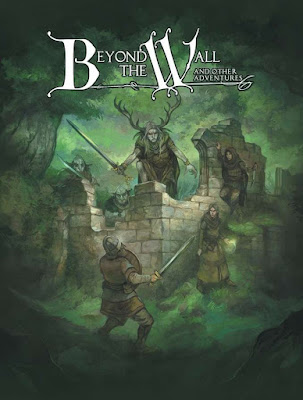
Beyond the Wall and Other Adventures: Review


Pitched as "a zero-prep OSR roleplaying game you can play in an afternoon," Beyond the Wall and Other Adventures has quickly become one of my go-to games to run. Even better, with the addition of the Further Afield supplement, it goes to a game perfect for a no-prep one-shot to a game well suited to a low prep on-going campaign. First, though, why pick up Beyond the Wall?


  • Easy to understand rule-set, that captures the feeling of AD&D with lots of the fidgety bits and rougher edges sanded off. Almost all the rules a player needs are summarized in a half-page as part of their playbook. Speaking of the playbooks...
  • Innovative, evocative and easy-to-complete character creation. With 40 (FORTY) playbooks, almost all of which you can get for free in printable PDF format, there's no shortage of player character options. Named perfectly, each playbook title provides it's own summation of what a character will be much better than "Fighter" or "Arcane Trickster". A few of my favorites include.
    • The Assistant Beast Keeper
    • The Future Warlord
    • The Nobleman's Wild Daughter
    • The Reformed Bully
    • The Would-Be Knight
    • The Village Bear
  • But not only do the playbooks walk a player through character step-by-step with 7 tables to roll randomly on or choose options from, Beyond the Wall uses those same tables to have the players (and gamemaster) collaboratively create the party's home village, generating locations, NPCs and ties between the PCs. (You can hear how that all comes together by listening to the Session Zero of our Antagonist Relations Beyond the Wall actual play podcast).
  • The scenario packs for one shot games are well-designed, no-prep and tie into the playbooks well. The GM adds to the pre-made tables with NPCs and locations created by the players, which means that the PCs start with investments in the plot (You can hear how that ties in by listening to my Lonely Fun Beyond the Wall setup podcast episode.)  This means that the PCs aren't just going to random NPC A for information or hearing about weird location B for the first time in some block text, but that they feel like they helped shape the NPCs and locations that come up in play.
  • Each scenario also features helpful suggestions and sample monsters to use during play, making them easy to use at the table.
  • There are a few things that might throw some people off though...
    • It's definitely low magic, Fireball is a 5th level ritual that takes 5 hours to cast.
    • It has AD&D inspired saving throws that you have to roll above and ability checks where you need to roll below your ability score. (There are optional rules to avoid these in the book, but the assumption is the more OSR style).
    • It's not built for players who want to created highly customized, min/maxed characters or strange combinations. The playbooks definitely focus more on character history than unusual class and race combinations. Also, while there are options for Dwarves, Elves, Gnomes and Halflings, Humans are decidedly the default.
Still, it is well worth picking up if you have any interest in having an easy to pick up and play, old school feeling system that's perfect for one-shots. And if you want to hear more about what Further Afield adds, click here to see my review of that supplement (spoiler, I like it just as much).

Friday, February 10, 2017

Powered by the Apocalypse Style Looks for Fantasy RPG PCs


One of the little things from many (but unfortunately not all) Powered by the Apocalypse (PbtA) games that I think makes character creation really shine is the "Look" options. I've actually borrowed this for non-PbtA one shots, like when I ran my Planescape "Soup" one-shot (sample PCs here). While most PbtA playbooks (class write-ups) have only three or four look "slots" with four options each, I wanted to build off that to make a table of look options that could be easily used for non-PbtA fantasy RPG games, either for players wanting to come up with character appearance descriptions or for GMs who want to provide look options for PCs for one-shot games, like I do. The list is mostly based off the look options found in the Dungeon World SRD.

Obviously not every "slot" needs to be filled, if there's not an appropriate Skin/Other option for a character then don't worry about picking one (or providing options). Likewise, while I really enjoy the Voice options, those are probably ones that will often be skipped by players who intend to roleplay their character's voice or who don't want to always be trying to speak in a "booming voice"

Two examples of how to use this chart. First, imagine a player building Matilda Boomhammer, Dwarf cleric of a Thunder God. Flummoxed at how they should describe their PCs appearance they consult the table and pick some things that fit their conception of the PC, ending up with...

  • Smoldering Eyes
  • Battered Helmet
  • Sweet Face
  • Battleworn Armor
  • Sturdy Body
  • Braided Beard
  • Calm Voice
Or perhaps a GM is creating characters for an one-shot game and while they are picking stats and powers, they want to leave choices for the players to make to encrourage what might be an otherwise disposable PC to feel like it belongs to that player. One of the PC options is a human wizard, so the GM provides these for the look options...
  • Cold eyes, Crazy Eyes, Knowing Eyes, Searing Eyes
  • Messy Hair, Pointed Hat, Strange Hair, Tattooed Scalp
  • Bony Face, Cruel Face, Plain Face, Striking Face
  • Dark Clothes, Flowing Robes, Strange Robes, Worn Robes
  • Emaciated Body, Pudgy Body, Knobby Body, Wiry Body
  • Nervous Hands, Ritual Scars, Unusual Jewelry, Waxen Skin
Then when a player chooses the human wizard, they don't have to come up with a look from scratch and their choices will get to add some personality to the PC they portray for the one shot, as a human wizard with "cold eyes, a tattooed scalp, a cruel face, dark clothes, an emaciated body and waxen skin" feels very different from a human wizard with "knowing eyes, a pointed hat, flowing robes, a knobby body and nervous hands".


Click here for a printer friendly PDF.

It goes without saying that these are just a starting point and meant as inspiration, if you're using them and find yourself drawn to a description that isn't on the list, you should go for it instead of limiting yourself.

Options with an *Asterisk were put in to help support more unusual races like Tieflings, Minotaurs and Dragonborn


Eyes Hair/Head Face Clothes/Garb Build Skin/Other Voice
Cold Eyes Bald Aristocratic Face Animal Skins Built Body Battle Scarred Skin Booming Voice
Crazy Eyes Battered Helm Blunt Face Battleworn Armor Bulky Body Braided Beard Brittle Voice
Dead Eyes Braided Hair Bony Face Camouflaged Garb Compact Body Calloused Skin Calm Voice
Eager Eyes Carved Horns* Boyish Face Cape Creepy Body Flexible Hands Crackling Voice
Fiery Eyes Cropped Hair Broken Face Ceremonial Garb Emaciated Body Flowing Beard Deep Voice
Glowing Eyes Dreadlocks Cruel Face Common Clothes Fit Body Many Piercings Flat Voice
Hard Eyes Fancy Hair Dull Face Dark Clothes Flabby Body Masked Face Grating Voice
Haunted Eyes Flowing Hair Expressive Face Fancy Clothes Graceful Body Nervous Hands Gravelly Voice
Haunting Eyes Furry Hood Flushed Face Finery Knobby Body Pale Skin Guttural Voice
Joyous Eyes Hooded Head Girlish Face Flowing Robes Lithe Body Perfect Skin Heartwarming Voice
Kind Eyes Messy Hair Gorgeous Face Habit Long Shanks Precise Hands Hoarse Voice
Knowing Eyes Mohawk Haggard Face Mismatched Armor Mighty Thews Quick Hands Lilting Voice
Laughing Eyes Plumed Helmet Handsome Face Polished Armor Pudgy Body Ritual Scars Loud Voice
Sad Eyes Pointed Hat Kind Face Poor Clothes Rangy Body Sausage Fingers Low Voice
Searing Eyes Pristine Horns* Lively Face Practical Leathers Ravaged Body Scaly Skin* Monotonous Voice
Sharp Eyes Scarred Horns* Mournful Face Ragged Clothes Scrawny Body Scarred Hands Penetrating Voice
Shifty Eyes Shaggy Hair Plain Face Scavenger’s Outfit Sharp Body Soft Skin Reedy Voice
Shrouded Eyes Shorn Hair Plump Moist Face Scraps Stocky Body Strange Brands Rich Voice
Smoldering Eyes Strange Hair Rugged Face Silk Clothes Sturdy Body Strange Tattoos Roaring Voice
Tormented Eyes Styled Hair Smooth Face Strange Robes Supple Body Tanned Skin Soft Voice
Warm Eyes Stylish Cap Stern Face Stylish Robes Thin Body Unmarred By Decoration Soothing Voice
Watchful Eyes Tattooed Scalp Striking Face Traveling Clothes Tiny Body Unusual Jewelry Stentorian Voice
Weary Eyes Tonsure Strong Face Weather Inappropriate Clothes Well-Fed Body Waxen Skin Stern Voice
Wild Eyes Top Knot Sweet Face Weathered Hides Wild Body Weathered Skin Sultry Voice
Wise Eyes Wild Hair Weathered Face Worn Robes Wiry Body Wrinkled Skin Whispering Voice

Tuesday, October 25, 2016

Party Time - Voltron as Inspiration and other recent Party Building & Character Creation

Or how can a GM trick his players into forming a party that is both this
 and occasionally this...


Thomas insisted that I give the new Netflix reboot of Voltron, Voltron: Legendary Defender, a try, and I'm incredibly glad I did. I have very few memories of the Voltron TV series that aired on American TV in the 80s. I'm certain I saw re-runs in syndication and I had the Voltron figure that combined all 5 lions, though I lost the sword and paladin figures before I started elementary school. Which is to say, I knew Voltron, but didn't have many definite and concrete memories and went into Voltron: Legendary Defender with only hazy memories of what came before.

Now, I won't try to claim that V:LD is high art or ground-breaking for a 'kids show' in the way that I might for Adventure Time, Steven Universe or Over the Garden Wall, but I did find it enjoyable and I'm looking forward to the second season. There's a slow bit in the middle of the series with some rock people and a friend remarked to me that there's a lot of it that revolves around them not being able to or wanting to form Voltron, but what I keep going back too as I think about the show is how it could be an excellent model for a D&D style adventuring party.


Tuesday, December 2, 2014

6am Sunday Morning - Time to game! (13th Age thoughts)

I've now played 13th Age twice through the FUTURISTIC MAGIC OF THE INTERWEBS. Though long discussed between John, Thomas and I, we never managed to get an simultaneous online game going (though we did play my troubled VtDA game and may still play a hopefully less troubled Vampire game that Thomas has been threatening to run for half a year now.) but now we have and it's been a blast. Due to wacky time zone differences we play at what is my 6 or 7am in the morning (Thomas is 10 hours ahead of me and John is 5 additional hours ahead of Thomas...) but it's been well worth the early rise, mostly because Thomas and John are two of my favorite people to game with. So here are my thoughts gathered so far based on two early morning sessions of 13th Age played with Roll20 online.

A Billion Years in the Future... Running Numenera

Decanted, a robot with a human head in it's chest.  Pretty sure my players weren't fans.

I ran Numenera last Friday. Originally, I had planned to end my GM break by running an Unknown Armies horror game, but alas events (a surprise evening in the ER) and poor organization (I did not heavily recruit players for the game and so on Monday the even had 1 confirmed player and 2 maybes and it was only on Friday afternoon itself when potential players told me they wanted to play) prevented that from occurring
Instead I ran a Numenera scenario I had been toying with for a while as it was easier to run on the fly and much less emotionally draining than my Black Friday themed horror show. Still plan on running that, so I'll have to just gather up four or five brave souls who wouldn't mind an evening of harrowing, but what follows here are my thoughts on running Numenera for the first time.

Saturday, November 15, 2014

What does the Protagonist Want? Because I usually have no idea.

(title of the blog post stolen from the incredibly awesome What Does the Protagonist Want? which is well worth a read)


     Thinking about Numenera character creation, my frustration with D&D 5E backgrounds (and Dungeon World bonds and alignments to a lesser extent) and consider several GM advice books which suggest using sentence pitches for campaign planning and adventure design, I've been thinking about how to apply sentence summaries to more things, like PC motivation.
     Toying around with the idea of running a Numenera one shot sometime in December/January and realized that the Sentence Character creation could be extended ever so slightly to add a character goal or motivation to the current structure.
     As a reminder, Numenera character creation boils down to " I am a [adjective] [noun] who [verbs]." So a former commando turned mercenary who recently discovered that she has a supernatural or technological knack with animals might be "I am a Stealthy Glaive who Controls Beasts". Why not add a want clause, like "Who wants to [motivation/goal]." So then if the former commando woke up as the only survivor of a battle and that's when she had this new connection with animals, perhaps her character summary sentence would be "I am a Stealthy Glaive who Controls Beasts and wants to Discover Why She Has this new Power." Hopefully a compelling character and it certainly gives the GM a few ideas of what the PC can do and what the player would like to do. It also provides an easy reminder to the player for their motivation, ie, their PC should be working to understand or uncover why she has this new affinity with beasts. One advantage of this, is that it forces the player to distill down a few things that they know they are interested in exploring in the game.
Let's try this out with my other PCs, adapting the Numenera character sentence structure to other systems.

Tuesday, October 21, 2014

A Few Problems with D&D 5E Backgrounds

As I've read the new 5E Player's Handbook, had players create new PCs, recreate old PCs and use pre-made PCs I've come to realize that I have a few problems with them.  That's not to say that they're not a good addition to the game, just that there are things about them I'd like to tweak.

Here are the shortcomings that I've found so far:

  • They don't tie the party together.  
    • Seriously, this is a big one.  The backgrounds all seem to focus on where the character came from and a little on how the character fits into the world or is motivated to adventure, but they provide very little that ties one character to another in a party.
    • Unlike Dungeon World bonds, there's nothing in any of the backgrounds that clearly indicates how your character would be bound to the other weirdos in your band of thieving murder hobos, I mean, your party.
  • They're not great about providing plot hooks/reasons to adventure.
    • Here is an example of how a player could make a character with the Entertainer background who has no plot hooks/reasons to adventure taken from the background.
      • Personality Trait: "I'll settle for nothing less than perfection." (This one almost screams "I won't last long adventuring" to me).
      • Ideal: "Beauty. When I perform, I make the world better than it was. (Good)." (Might be an admirable Ideal, but it doesn't really give the player any idea why the entertainer might decide to travel far from the crowds of a city or village to battle goblins in a wild forest or skeletons in a dungeon).
      • Bond: "My instrument is my most treasured possession, and it reminds of someone I love." (This one almost, almost could read of a plot hook, but not quite.  As a DM I'd be tempted to steal the instrument and use that as the hook, but the very next bond down in the PHB is that very shtick, so a player who chooses this bond doesn't want that or they would have chosen it.)
      • Flaw: "Despite my best efforts, I am unreliable to my friends." (Honestly this one just reads to me like that character is just going to oversleep in the inn while the rest of the party fights the orcs.)
    • Maybe I'm being a little uncharitable, but really, what I want from the backgrounds is to provide impetus to the player, to give them a few easy sentences to refer back to when they inevitably go "wait, why does my character care about this Lich again?"
    • I think a better implementation would be to have every Ideal provide motivation and every Bond provide a plot hook or at least a jumping off point (ie. the Entertainer's Bond of "I want to be famous, whatever it takes." at least provides a reason why that character would be an adventurer.
  • Finally, my last problem with the backgrounds is that many, many more than I like encourage players to just be annoying, the Personality Traits and Flaws especially.
    • Some examples, all taken from the Sage background.  Keep in mind that there are only 8 Personality Traits and 6 each of the Flaws presented in the book as examples.
    • Personality Traits
      • I... speak...slowly...when talking...to idiots...which...almost...everyone...is...compared...to me. (Yeah, that's going to go over well with the other PCs and NPCs.)
      • I am horribly, horribly awkward in social situations. (This one isn't as bad as the other two examples, but it doesn't take much imagination to see how it could become annoying if not done well.)
      • I'm convinced that people are always trying to steal my secrets. (Another one, not as egregious as the first example, but with plenty of room for it to be implemented poorly.)
    • Flaws
      • I speak without really thinking through my words, invariably insulting others. (Really not necessary since 2 of the 8 personality traits, a full quarter of the options presented pretty much have the same impact as this flaw...)
      • I overlook obvious solutions in favor of complicated ones. (Probably not too bad, but also a possibly abused 'flaw')
      • I can't keep a secret to save my life, or anyone else's. (This one is actually interesting and could be done well, but I also cringe to imagine it being played as an annoying blabbermouth).
    • And unfortunately the Sage is not an isolated example of backgrounds which have options which easily sink into the "just annoying for the other characters" trap.
But, not wanting to just point out flaws, I plan on taking some time to present additional options for the backgrounds in the PHB that provide additional options that hopefully will provide better motivation and more interesting personality traits and flaws that will at least be more interesting, even if they are still a little annoying.

Monday, April 28, 2014

LARP's Lessons Lost

A Blog Post Wherein I Play the Fool.


I used to run and play in a lot of LARPs, or Live-Action Role Playing games for those of you who have arrived at this blog from some other dimension, and some of those games were shit.  Not "the shit" as in good, though some of them were the shit, but some were terrible shit, as in shitty and terrible games.  And I'm talking about the games I ran as well as the games that I played in.  I have run some shit LARPs in my day.  Many of these games I played in, wrote or ran, I also played in, wrote or ran with Thomas and because we enjoy talking about games nearly as much as we enjoy playing them and because it is often easier to talk about games just the two of us than to find a group, schedule a time and play a game, we talked about the problems that we found with LARPs a lot.

Of course, not having played, run or written a LARP in a few years, I forgot all my LARP gripes and lessons when I started running an online influence game using a mishmash of the original World of Darkness Vampire the Dark Ages or VtDA (actually the confusingly re-named Dark Ages: Vampire which has an less impressive DA:V acronym) and a heavily modified Influence System derived mostly from Mind's Eye Theater (MET) Dark Epics.  Since I've been more focused in the last several years on party-driven tabletop games like D&D or even more story-driven games like Dread and Apocalypse World, I let my years of LARP experience go almost completely untapped, much to the detriment of the game I was running.


Sunday, February 2, 2014

In the Lair of the Ginger Giant: Antagonist Relations Podcast Episode One: Roll Initative

The inaugural episode of the new podcast I'm doing with Ben of Because In a Blog No One Can Here You Scream.

We discuss:

  • Games we've played, run and want to play in the future.
  • Ben's thoughts on D&D Next after playing in the weekend-long session I ran of White Plume Mountain in celebration of my 30th birthday.
  • The Player Principles I outlined in my recent blog post: Principled Playing
  • And answered some listener questions to "Dear Dungeon Master"


Listen and download here: In the Lair of the Ginger Giant: Antagonist Relations Podcast Episode One: Roll Initiative

Let us know if you have comments, feedback or are interested in being a guest to talk about running or playing in RPGs.

Wednesday, February 20, 2013

Introducing Guðleifr the útlegð AKA Gleb the Exile

So last Saturday was the character creation session for the new D&D game that inspired my last two character creation manifesto posts (parts 1 and 2).  As previously threatened, I made good on my promise to Citizen Ben to hijack the game, standing before the seven other players and pontificating about what I thought the party goals and game plot should be, as well as shepherding all through the character creation process.   The other players decided on the following:
  • Aldous Kordam - Satyr Skald
  • Alora Aluringcast - Eladrin Arcanist
  • Samir Dastinky - Dwarf Slayer
  • Hyrulan - Elf Sentinel
  • Ichiro Katsou - Half-Elf Swordmage
  • Zarach - Githzerai Avenger
  • ??? - Halfling Storm Sorcerer

And I, of course, went with my plan to play Guðleifr the útlegð AKA Gleb the Exile, Goliath Barbarian.


Saturday, February 9, 2013

Character Creation III-Part 2 - 2 Examples


Continuing on my last post, here are two examples of character creation. I worked through creating two PCs in order to apply many of my ideas from that post...

Thursday, February 7, 2013

Character Creation III

I’ve been thinking about character creation and party building as I plan the hijack Citizen Ben’s second D&D group that he’s starting up this month.  I think he thinks that I’m just joking about hijacking the game, but I’m actually deadly serious.  I’m taking the opportunity to apply to this new game what I’ve been thinking about RE: Characters, backgrounds, goals, plots and party cohesion from the two games I’m running, my Gritty Fantasy Last Rest Reign campaign and my Future Noir Fading Suns, plus Citizen Ben’s first D&D game that I’m playing.  If I’m going to disappoint my girlfriend by dedicating time to a fourth RPG game, bringing my monthly RPG sessions that bite into our time from five up to six I intend to get exactly what I want.

Friday, December 28, 2012

Serious Business, Character Business

The Monarch: " (sighing) Jollyrancher82, never get henchmen.''
Jollyrancher82: "You know, that's not my real name.''
The Monarch: "Well, how was I supposed to know? I used my real name.''
Jollyrancher82: "I just thought, you know... "The Monarch," I thought you were into cosplay...''
The Monarch: "Real name! And I am into costumed business, not costumed play."
 The above quote has very little to do with this post, but it does encapsulate how serious I am about Character Business.  Not business in the sense of Neckties and Profit-Margins, but business in the theatrical sense, that is:
9. An incidental action performed by an actor on the stage to fill a pause between lines or to provide interesting detail.
 14. (Performing Arts / Theatre) Also called stage business Theatre an incidental action, such as lighting a pipe, performed by an actor for dramatic effect (http://thefreedictionary.com/business)
Character Business is one of the things that can make or break a game for me.  PCs with good character business can rescue a dreary plot and if done well can make a good game great.


Thursday, September 13, 2012

The Beginning of My Reign

Monday night saw the first session of my Reign game (which you can follow over at the Last Rest blog).  While all that was accomplished was character and company creation, I feel it was highly successful.  Before Monday, the last character creation session I had overseen was for two 4E D&D characters, which took almost two hours, even utilizing the electronic character generator.  Monday night I was able to guide six players through creating a character each and constructing, together, a company.  And whereas the D&D character creation yielded two playable sheets with very little background, personality or goals, each of the six Reign PCs created on Monday night has a rough background, potential goals and relationships and as the characters were being crafted I could tell that the players were also starting to develop character personalities as well.

The players decided to go with a smuggling outfit disguised as a merchant company working to assist the rebellion against the Witchlord's Ashen Kingdom.  We've got (if my memory serves) a merchant following in the family tradition, a noble kidnapped by mountain folk who rose to become their thane, a master thief who had been imprisoned by the Ashen Kingdom due to a case of mistaken identity, a gypsy turned sailor, a sorcery wielding archer and an Ashen Kingdom army officer who learned strange magics and turned to the rebellion after being imprisoned due to a political imbroglio.  I am certain that my brief description did not do justice to any of those characters and I hope to be posting backgrounds and descriptions of each soon on the Last Rest blog.

With the characters and company created, I've started planning the plot arc, keeping my Goal Posts in sight. I've decided on a starting point, I know two plot high points for the middle and I have an idea of the climax of the campaign.  I have some ideas on the antagonists and allies, from the character backgrounds as I understand them now, and I'll flesh those out and finalize them as I get finished backgrounds from the players.  Most importantly, I have three themes that I want to focus this first season of Reign on:

  • Family/Community
    • The game is going to focus on families, and on communities as the extension of family or as the 'created' family as opposed to the biological family.  Many of the players have a part of their background that involves being a part of a family or being opposed to a particular family and I'm going to play that up as well as introducing other families and communities for the players to impact as their characters make decisions.
  • Do The Ends Justify the Means?
    • I want the game to offer real moral choices to the players. The player's company is a smuggling operation, circumventing the laws, because it is an offshoot of a rebellion that sees those laws as unjust, but how far are they willing to take it?  Through out the game, the players will have to choose how far they are willing to go and will also see NPCs who draw hard limits on what they're willing to do for their believes and who are willing to do anything...
  • Justice/Vengeance
    • This may overlap some with "Do The Ends Justify the Means?" but I decided to make it a theme anyway.  Many of the characters have a person or group (including a family) that they want vengeance on, and I want to use these opportunities to focus on the difference between justice and vengeance.  Will the characters seek justice, where a kind of fairness or proportion might reign, or will they seek a kind of scorched earth vengeance?  They'll also encounter NPCs who also seek justice or vengeance.
These themes might change a bit after contact with my players and their characters, but for now, I think these will be the themes I start shaping the plot around.


Tuesday, September 4, 2012

Monday, September 3, 2012

Character Creation - True Background vs. Limited Future Choices

I'm gearing up to run my new Reign campaign and was chatting with Bob, a friend who'll be playing Reign but has otherwise played 4E D&D almost exclusively with  dashes of Mage, Mazes & Minotaurs and Dread thrown in as well.  As we chatted I realized how different character creation in D&D (and similar games) can be from a game like Reign.


No ICE in Minnesota itch.io bundle

My silly one page RPG about throwing a holiday party for vampires, That Familiar Holiday Spirit , is part of the No ICE in Minnesota bundle ...