Showing posts with label Review. Show all posts

Monday, December 29, 2025

Gateway to a World of Darkness - Hunter: the Reckoning 5th Edition Review


Full disclosure: I have been a paid contractor for Renegade Game studios working as a Test Reader on World of Darkness books that have included Hunter: The Reckoning 5th Edition products. I did not work on the corebook or any of the other products covered specifically in this review, nor was I paid for this review. This review is my personal opinion. That said, I am writing this review to help promote some upcoming Storyteller's Vault material I will be publishing for Hunter, so it is not entirely without Crassly Commercial motives. You can find my full list of RPG credits here.

TL;DR

I think Hunter: The Reckoning 5th Edition is a great introduction for new and returning players to the 5th Edition World of Darkness. It works well for both one-shots and longer chronicles, the rules are easy to explain and on the balance its strengths outweigh its weaknesses. I would recommend it to any Gamemaster or group interested in a modern day horror RPG focused on hunting the supernatural.

Tuesday, October 9, 2018

The Eternal Boundary - Review


The Eternal Boundary, the first published module for the 2nd Edition AD&D Planescape campaign setting, I was lucky enough to get a physical copy from a friend as a gift and have enjoyed running it twice. First, using 5th Edition D&D rules and some home-brew planar race and faction options and the second time this last summer using the original 2nd edition ruleset as part of my Roll20 Great Modron March campaign. I’ve touched on the Eternal Boundary module before when I discussed using Perplexities as Hooks but wanted to do a full review.

As the inaugural Planescape module, aside from two brief single page adventure prompts in the setting boxed set, the Eternal Boundary does a fantastic job introducing some of the seedier areas of Sigil as well as the kriegstanz or undeclared war between the factions and the power of belief in the setting.

Spoilers for the Eternal Boundary Follow...

Thursday, October 4, 2018

Great Modron March - Introduction & Chapter 1 Review

A few years ago, I picked up a PDF of the Great Modron March from the DMs Guild and then was busy running other games. Then, early last year I opened it and was immediately dreaming of getting to run it. Since I’d been playing in a 2nd Edition AD&D al-Qadim game, I decided that I wanted to run it with the 2nd edition rules it was originally intended for. A quick poll of my local players showed that I was going to struggle to get a consistent group to run in person, so I turned to Roll20 and haven’t looked back.

I’ve now run 15 sessions of the campaign, using Great Modron March as the backbone and weaving in other classic Planescape modules as well, notably The Eternal Boundary, Harbinger House and The Well of Worlds, and I would re-run this campaign in a heartbeat. I’ll review more of Great Modron March, as well as the other modules but this post will focus on an overview of the module and its first chapter.

Introduction and Background

As a Planescape fiend (pun intended), it was hard not to get sucked in by the allure of the Great Modron March… Eleven linked adventures that span from level 1 to 10 that take the PCs around the Great Wheel of the Outer Planes? Just that sounds fantastic, and that’s before diving deeper in. One thing I’ve noticed that sets the Planescape modules apart from other 1st and 2nd edition modules I’ve read is their organization. Most of them have a DM introduction, a synopsis and other bits that just make prepping much easier, and Great Modron March definitely benefits from these things. There is a great introductory chapter, a separate story prologue and then each chapter starts with a section called “Just the Facts, Berk” that lays out the Number of PCs, Levels, PCs Preferred, Factions involved and a Synopsis. This makes each chapter easy to run with relatively minimal prep.
One thing that I noticed as I read the entire module before beginning the campaign was the numerous hooks that a canny DM could seed, and so I put together a list of hooks for the players to choose hooks for their PCs that were interesting to them. Below is an abbreviated list of the hooks I pulled from the Great Modron March.

Hooks


  • Ydemi Jysson - a clerk at the Hall of Speakers in Sigil (Contact)
  • Hearth’s Faith, a small town on the plane of Mount Celestia
  • Sir Vaimish Crasad - a Paladin lord of the gatetown of Excelsior (Contact/Mentor)
  • The Tacharim - an evil order of nomadic knights that plagues the Outlands (Antagonist)
  • Lil’z Rou - Githzerai Sensate namer. (Contact)
  • Xaldra Miloni - Tiefling Indep and well-lanned party girl. (Contact)
  • Bachalis - Half-elf Indep Wizard – (Contact/Mentor)
  • Erinos Vail - Athar Mage in Rigus – (Contact/Mentor)


Another enticing prospect was the episodic nature of the module, where each chapter is reasonably self-contained and allows for other adventures to take place between the chapters of the Modron March. This has let me easily weave the other modules in, resulting in the chronology below.

Session - Module (Sessions are approximately 4-5 hours long)
1 Great Modron March Chapter 1
2 Eternal Boundary
3 Eternal Boundary
4 Eternal Boundary
5 Great Modron March Chapter 2
6 Great Modron March Chapter 3
7 Great Modron March Chapter 3
8 Well of Worlds Hard Time
9 Harbinger House
10 Harbinger House
11 Harbinger House
12 Harbinger House
13 Harbinger House
14 Harbinger House
15 Harbinger House
16 Great Modron March Chapter 4


More Spoilers for Great Modron March follow…

Tuesday, September 25, 2018

N1 in the time of 5E - Against the Cult of the Reptile God Review


Terror by night! The village of Orlane Is dying. Once a small and thriving community. Orlane has become a maze of locked doors and frightened faces. Strangers are shunned, trade has withered. Rumors flourish, growing wilder with each retelling. Terrified peasants flee their homes, abandoning their farms with no explanation. Others simply disappear...
No one seems to know the cause of the decay—why are there no clues? Who skulks through the twisted shadows of the night? Who or what Is behind the doom that has overtaken the village? It will take a brave and skillful band of adventurers to solve the dark riddle of Orlane!
One of my favorite modules and definitely my favorite of the 1st/2nd edition AD&D modules I’ve gotten to run/play, Against The Cult of the Reptile God is a fantastic low level module that you can easily translate to any fantasy RPG. I’ve now gotten to play it once, run it full through twice and I’ve broken it apart and used various pieces of it to set up the campaign and adventure locations in the Antagonist Relations Podcast Actual Play Beyond the Wall game.

What makes Against the Cult of the Reptile God great to run? (Spoilers follow)


Thursday, March 29, 2018

Beyond the Wall - Further Afield Review


If you've read my review of Beyond the Wall and Other Adventures, you know I think it's a great game for zero-prep one shots, but with the addition of the Further Afield supplement it becomes a great game for ongoing sandbox campaigns. Even if you don't use Beyond the Wall, the Shared Sandbox creation rules and Threat rules are a great addition to any game master's repertoire. So what's in Further Afield that makes it a great supplement to grab?

  • The Shared Sandbox. An entire chapter guiding you and your players through a collaborative sandbox creation setting (You can hear an example of this in our Session Zero Beyond the Wall actual play podcast episode).
    • Not just a set of random tables, it has the players decide some of the details of a location and in a stroke of genius, has a roll for the GM to make to see how much of what their PC knows is correct. This means that a player has some investment in the locations but that they can't be certain they already know what's there until they send their PC there in game.
    • After each player has created two locations, then each chooses a location another player created to embellish, adding another detail to the sandbox and letting players build off of each other's ideas.
    • There are plenty of tips and hints for getting the most of the process and helping it go smoothly as well.
  • After the players have filled in major locations, the game master will separately fill the map in with minor locations (You can hear an example of this by listening to my first Lonely Fun podcast, where I cover the prep I did for our Beyond the Wall actual play campaign).
    • There are tips for integrating favorite adventures into the map, for respecting what the players already added and for working with the threats detailed in the next section of the book.
  • Threats! Like fronts from Dungeon World, these are a great tool for having over-arching plot, driven by a villainous NPC or a magical phenomena. 
    • They're more structured than fronts, and have an imminence rating that can go up or down according to player action (or inaction).
    • At the start of each in-game week, the GM makes a roll and if it equals or exceeds the imminence rating then the threat is activated. Each threat has an activation chart of events that occur that could have direct or indirect effects on the PCs... for example, kidnapping children from the PCs' home village. Something the players might notice immediately or that they might only learn about when they return home after adventuring elsewhere.
    • There are four pre-made threats in the book, all of which are intriguing, and more available for free PDF download. They can be neutral or even potentially helpful to the PCs, like the Imperial City that is expanding into the PCs' homeland or they can be completely villainous, like the Blighted Land that expands, devastating everything in its wake until the PCs defeat it.
    • There are also guidelines for crafting your own Threats, which is something I'm trying out for the Antagonist Relations Beyond the Wall actual play podcasts, where I'll be making a Reptile Cult threat for my players to deal with.
  • Running the Campaign / Travel and Exploration
    • While not as potentially system-neutral as the Shared Sandbox and Threats, the advice in these two short chapters is very useful for anyone running a sandbox/hex crawl campaign.
  • Optional Rules
    • The remainder of the main portion of the book until the appendices is largely optional rules for Beyond the Wall. There's guidance for dealing with PC death and new characters, character traits which are like feats for BtW, advice and options for the experience system, more items, treasure and magic.
  • Appendices
    • The first appendix is a few more optional rules for BtW, but Appendix II: Sample Regions has some great generic encounter tables and Appendix III: Minor Locations is a great page of tables to quickly generate interesting locations on the fly or to use to fill out a hex map.
  • Threats and Play Aids
    • The four sample threats are here, the Blighted Land, the Grey Prince, the Imperial City and the Vengeful Wyrm. I've not had a chance to run a game with the Blighted Land, but the other three have been fantastic for driving the plot of my Wednesday Beyond the Wall campaign that's been running  since May 2017.
    • The other play aids are great too, and you can find them for free at the Flatland games site! The Campaign Worksheet is used during the Shared Sandbox creation and Convenient Lunar Calendar could be used for any game that needs an easy to use and basic calendar.

Overall, I cannot recommend Beyond the Wall and Other Adventures and Further Afield enough. They're a great addition to any tabletop gamer's shelf. And while you pick those up, do yourself a favor and grab all the great free content they've put out there to support the game as well.

Monday, March 26, 2018

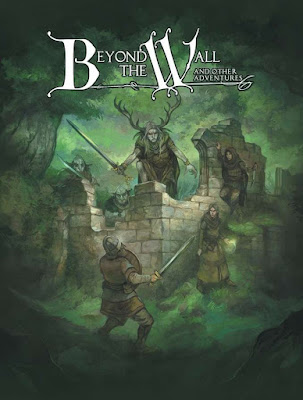
Beyond the Wall and Other Adventures: Review


Pitched as "a zero-prep OSR roleplaying game you can play in an afternoon," Beyond the Wall and Other Adventures has quickly become one of my go-to games to run. Even better, with the addition of the Further Afield supplement, it goes to a game perfect for a no-prep one-shot to a game well suited to a low prep on-going campaign. First, though, why pick up Beyond the Wall?


  • Easy to understand rule-set, that captures the feeling of AD&D with lots of the fidgety bits and rougher edges sanded off. Almost all the rules a player needs are summarized in a half-page as part of their playbook. Speaking of the playbooks...
  • Innovative, evocative and easy-to-complete character creation. With 40 (FORTY) playbooks, almost all of which you can get for free in printable PDF format, there's no shortage of player character options. Named perfectly, each playbook title provides it's own summation of what a character will be much better than "Fighter" or "Arcane Trickster". A few of my favorites include.
    • The Assistant Beast Keeper
    • The Future Warlord
    • The Nobleman's Wild Daughter
    • The Reformed Bully
    • The Would-Be Knight
    • The Village Bear
  • But not only do the playbooks walk a player through character step-by-step with 7 tables to roll randomly on or choose options from, Beyond the Wall uses those same tables to have the players (and gamemaster) collaboratively create the party's home village, generating locations, NPCs and ties between the PCs. (You can hear how that all comes together by listening to the Session Zero of our Antagonist Relations Beyond the Wall actual play podcast).
  • The scenario packs for one shot games are well-designed, no-prep and tie into the playbooks well. The GM adds to the pre-made tables with NPCs and locations created by the players, which means that the PCs start with investments in the plot (You can hear how that ties in by listening to my Lonely Fun Beyond the Wall setup podcast episode.)  This means that the PCs aren't just going to random NPC A for information or hearing about weird location B for the first time in some block text, but that they feel like they helped shape the NPCs and locations that come up in play.
  • Each scenario also features helpful suggestions and sample monsters to use during play, making them easy to use at the table.
  • There are a few things that might throw some people off though...
    • It's definitely low magic, Fireball is a 5th level ritual that takes 5 hours to cast.
    • It has AD&D inspired saving throws that you have to roll above and ability checks where you need to roll below your ability score. (There are optional rules to avoid these in the book, but the assumption is the more OSR style).
    • It's not built for players who want to created highly customized, min/maxed characters or strange combinations. The playbooks definitely focus more on character history than unusual class and race combinations. Also, while there are options for Dwarves, Elves, Gnomes and Halflings, Humans are decidedly the default.
Still, it is well worth picking up if you have any interest in having an easy to pick up and play, old school feeling system that's perfect for one-shots. And if you want to hear more about what Further Afield adds, click here to see my review of that supplement (spoiler, I like it just as much).

Sunday, March 18, 2018

Godless: The World of Fire and Blood (review)


GODLESS: The World of Fire and Blood


This is the Shadow of the Demon Lord system with a post-apocalyptic setting bolted on and man, oh man, does it work better than I expected. There’s not a ton of alteration to the stuff from the base SotDL game, the ancestries get a post-apocalyptic background, the Clockworks become Transcendent, more cyborg than steeampunk. All the fey ancestries lose iron vulnerability and a few other things are tweaked, but for the most part it just adds the post-apocalyptic stuff. This does mean that you need a full copy of Shadow of the Demon Lord to play Godless, but you went out and picked that up right after my initial review on my recommendation, right?

It’s got all the strengths of SotDL: the stripped down, mostly intuitive, easy to run rules. The excellent path mechanic for advancement are kept, with a few new post-apocalyptic paths provided like Grease Monkey and Road Warrior. The specificity of the tables from SotDL, the interesting things that gave the game so much flavor are just as perfectly seasoned for a post-apocalypse in Godless; take this sample pair of interesting things: “A self-help book written by Tony Robbins” and “A bag of plastic toys made to look like food.” It sands off a little of the unevenness of SotDL as well, by leaving the setting largely unspecified, instead just providing suggestions for how to “Destroy Your World” to generate a post-apocalyptic Earth.

So what’s new? First, and one of the things I like best, are stories. Stories are a bit of character creation business in Godless, a more robust background mechanic than the core book. Which could be kind of confusing but look at it like this, the ancestry backgrounds are interesting, dangling hooks, a sentence or two, like this human background from Godless “An overprotective mother kept you locked in a cellar for your entire childhood. You escaped after she died.” Just a bit of strange character development meant to jolt a player’s imagination. The stories however, well, I’ll let Godless explain it “Characters in the World of Fire and Blood have endured much hardship and struggle before the game even begins. The stories of their past inform how they fit into the present and give guidance about how they might develop as the campaign unfolds.” Unlike the backgrounds which might give an interesting thing or a bit of corruption or insanity, each Story gives professions and a mix of benefits and hindrances. Take the Deluded story, for example…


Deluded

A rash of new religions appeared following the Cataclysm. Dismayed by the false promises in their holy books, people invented their own faiths—some new interpretations of the old, others invented from whole cloth. You follow one of these new religions and are called deluded because you cling to your faith in the face of the indifference of the cosmos.
  • Professions: Gain one profession from the Fanatic table and one random profession.
  • Strong Beliefs: When you would make a challenge roll, you can choose to make that roll with 3 boons. Once you do so, you cannot use this talent again until you complete a rest.
  • Righteous: Your faith guides you through a world of unrest and uncertainty. After you complete a rest, you must spend 1 hour in prayer. Until you do so, you are impaired.


Brief, but flavorful, beneficial but not too constraining. A PC with the Deluded story could go on to take the Priest novice path, but it would work just as well for a Rogue, Warrior or Magician path. But tucked away there, where you might almost miss it there’s a little hint for the player for how their PC will interact with the world: “You follow one of these new religions and are called deluded because you cling to your faith in the face of the indifference of the cosmos.” The other nine stories are equally as good, providing both a launching pad for a PC and a sense of a character arc or direction for the player to keep in mind.

I didn’t get a chance to test out the Vehicle rules, but they look to straddle that sweet spot of providing enough options to have a really good car chase seen and not so many fiddly bits that it’s a massive pain to run. The new spells, creatures and items are all excellently suited to the post-apocalyptic feel and include things like explosives, zip-ties, spells to process fuel, tolerate radiation and the Inheritors (sentient man-sized cockroaches).

While there are only three adventures for Godless (as of March 2018), they are every bit as well-crafted and easy to run as the Shadow of the Demon Lord scenarios. I ran two of them, In a Pig’s Eye and Dancing in the Ruins.

***SPOILERS FOR THE ADVENTURES FOLLOW, YOU HAVE BEEN WARNED***

Friday, February 17, 2017

13th Age - The Strangling Sea Review and Recap

(Find it at... Pelgrane Press  / Drivethru RPG / Amazon)

I choose The Strangling Sea to kick off my new Eyes of the Stone Thief campaign, not just because it was a published 1st level adventure that I could run without much prep but because it is an excellent adventure and tailored towards GMs who are new to running 13th Age. While I am not new to running 13th Age, it was still nice to have the extra advice in the adventure to guide me as I gear up to running an ongoing campaign that I hope will cover 1st through 8th levels.

Major spoilers for The Strangling Sea adventure follow, obviously. I'll do the review first and the recap of my players second, so that readers who just want a review of the adventure don't have to stick around for the hi-jinx of my players.

Wednesday, February 1, 2017

"Pitchfork Sad" - A review of Shadow of the Demon Lord


Shadow of the Demon Lord! I remember vaguely seeing kickstarter announcements and then stumbled back across it this summer after it was out in print and decided to give it a look. And man, am I glad I did.

The brief pitch of why I enjoy Shadow of the Demon Lord is this... simple, familiar but distinct d20 rules, with interesting races (hereafter referred to as Ancestries, as SotDL does), flexible class options (called Paths by SotDL), compelling monsters, a deadly and dangerous world to explore and a very distinct feel that pervades the system and setting that makes it feel very distinct from D&D. The splatter-gore meets crazed whimsy and dark mystery of the setting gels much better than I was expecting, walking a fine line sometimes between silliness and horror, as evidenced by the goblin warlock art below...


Anyway, if a darker game that allows for some wackiness and lots of random tables for character creation is what you like stuffed into your roleplaying sausages, then read the full review below for a taste of what goes into the meat grinder. (I was going to go with "is your jam" but I figured sausage making was a much more apt metaphor for SotDL, being both a bit sillier/juvenile and also a bit more grisly.)

Also, new table of random Human Skin Tones below! Or click here to skip to that...

Monday, June 6, 2016

Elemental Magic of Zahkara - A somewhat biased review


So fair warning, this is far from unbiased, as I gave development feedback as this was being written, but you should all check out Elemental Magic of Zakhara. Based mostly on 2nd edition Al Qadim sourcebooks, Thomas has done an excellent job bringing the flavor of Zakharan Elemental wizard traditions into 5th Edition. Not only are the five wizard traditions provided more thematically coherent and interesting than most of the core traditions from the Player's Handbook (I'm looking at you Conjurer) but there are options for Elemental Monks, quick options to turn a boring Eldritch Knight into an exciting Inferno and Earthquake Knight with access to the domains of Flame and Sand or make an Arcane Trickster Pirate who gets spells of Wind and Sea.

To say nothing of the fifty plus spells which fill the much needed gap of elementally thematic utility spells (while not neglecting to add interesting and well-done attack spells). And then as if that wasn't enough, there's a write up of how to use the Brotherhood of True Flame as a faction.
Needless to say, but for the last week or so I've been wishing I had a game to play in where I could play a Zakharan wizard, though I can't decide at all whether I'd want to play a Sea Mage Pirate, enjoying blasting enemies with a Cone of Teeth, with it's evocative flavor text of “The spell leaves a bit of water on the ground (and often blood too), and extinguishes candles and other small flames.” or a Wind Mage with a Flying Jambiya and flying Wind Carpets to look forward too. Or a Magician who could combine the best of Wind and Sea, commanding a ship with Ghost(ly) Rigging and drowning opponents with Command Water Spirits. Never mind that other times I'm dreaming of running a Sand Mage, able to put a spell, like Sleep or Charm Person, into a handful of sand to toss onto an adversary and Sand Tools and Sand Blades available at a moments notice.

In addition, it's a mighty fine looking product, one of the best formatted I've seen so far (in my admittedly still limited) perusing of the DM's Guild. With 27 jam packed pages of content, it is more than worth a buck or two, in my humble opinion. You should check it out, give it some feedback, a rating or review (since I've refrained out of propriety) and enjoy.

You can find Thomas' other excellent DM's Guild products here.

Wednesday, October 28, 2015

Grim World + Love Letters & Extra Life Thanks

Last Saturday I ran Grim World as a "pre-Halloween" one-shot game, which was a lot of fun and a few caveats. I'll provide a review below, but my biggest caveat was I put out a large invitation to 10+ players, thinking, as I often do, that I'd be lucky to get the four players I'd need to run... Instead, and much to my surprise, I ended up with 8 players (and 7 PCs, since there was some question if the 8th player would be able to attend so he shared a playbook with his GF) and as I always do when I run really large groups of players, I felt like I didn't do the best job of giving each PC a shot in the spotlight and let things get a little more chaotic and bogged down than I liked. But that's all on me and not on the players.

Speaking of, thanks to the incredible generosity of the players, Christy and I managed to raise $135 for Extra Life between the two of us.  I'm now over 75% to my goal (as of 10/28/2015) and if any of the players from the Grim World game want to go back and retroactively ask for any of the rewards I was offering, you certainly can. If you are a regular reader of the blog and haven't pitched in any support for the Extra Life campaign yet, we're nearing the end, with a little over two weeks left, so I hope you'll consider a donation, even if it's just $5.

Click here to skip the Grim World Review and go straight to my further thoughts on Love Letters...


No ICE in Minnesota itch.io bundle

My silly one page RPG about throwing a holiday party for vampires, That Familiar Holiday Spirit , is part of the No ICE in Minnesota bundle ...